‘Open Emergency-Like Situation’ Across the Country, Says CJP; We Will Keep Protesting Till the CEC Goes
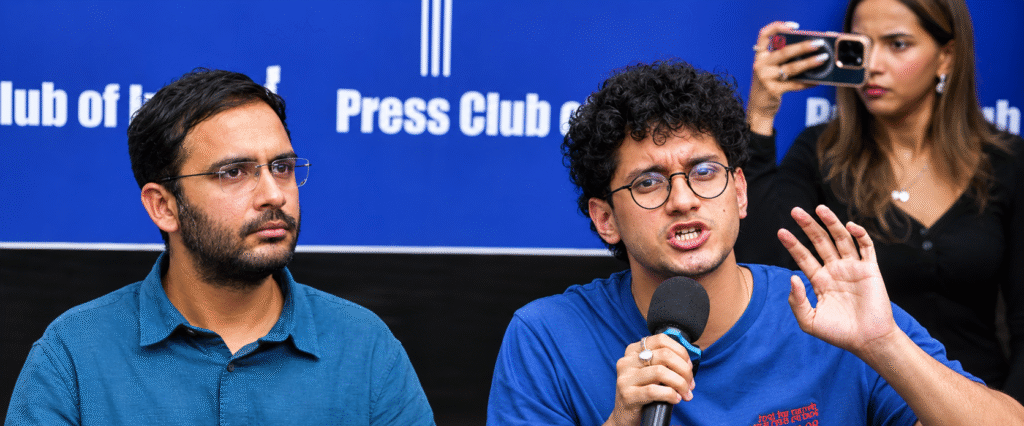
New Delhi: Just a few hours after they walked out of detention, the Cockroach Janta Party leaders stood at the Press Club of India on Sunday and spoke the way people actually speak when they’re angry and tired. Saurav Das looked at the reporters and said the whole country right now feels like an open emergency. The kind we last saw in 1975. “Delhi has been turned into a cantonment,” he said. Thirty to forty thousand security people everywhere. Fifty-seven metro stations shut. Rajdhani trains cancelled. Markets forced closed on a Sunday. Ordinary people made to suffer so that they start blaming the protestors instead of the government. He said the Modi government has put the state against its own citizens. They could have simply called a few of us for talks. Instead they locked the capital down. The CJP wants Chief Election Commissioner Gyanesh Kumar to resign. They say the Special Intensive Revision of voter lists is full of problems and the right to vote itself is under threat. The Election Commission denies everything, of course. Das, Ashutosh Ranka and founder Abhijeet Dipke had been picked up the day before as soon as they landed in Delhi. On Sunday a magistrate let them go after they put up Rs 50,000 surety each and agreed not to “breach the peace” for one year. Das almost laughed when he talked about that condition. “They say we should not breach the peace for one year. The people who breached the peace are Narendra Modi, Amit Shah and Gyanesh Kumar.” Ranka was plain. “This protest will not stop till Kumar resigns.” He said Jantar Mantar is a designated protest site. Peaceful protest there cannot be called a breach of peace. “Protests will happen, not just in Delhi, but across the country,” Das added. Saturday had been heavy. Police say about 2,500 people were detained. Other numbers going around are closer to 7,000. Central Delhi sealed. Mobile networks cut in places. Force brought in from Kashmir, Bengal, Naxal areas. The CJP says phones of detained activists were taken without proper papers and they fear the phones have been compromised. Journalists covering the protests were also hassled, according to them. Opposition leaders are saying the same thing. Congress president Mallikarjun Kharge called it an undeclared emergency. He and Rahul Gandhi plan to meet the Chief Justice of India. Gandhi said the more they try to suppress Gen Z, the angrier the young people will get. Police keep saying everything was done by the book to keep order. The heavy deployment will stay because more protests are expected. The Supreme Court has already said no illegal detention of peaceful protestors and that metro and trains should run normally. The CJP started as a Gen Z response after a court remark about jobless youth and cockroaches. They are not a registered party. They just keep saying the same thing: free and fair elections cannot happen with this CEC. Kumar has to go. The SIR has to be fixed. At the press conference they made it clear. We did not sign any bond that stops us from coming back on the streets. The protest is on. It will not stop until the Chief Election Commissioner resigns. And right now, they say, the country is living through something that looks and feels exactly like an open emergency. Sources: Economic Times, News9live, BBC, New Indian Express, Indian Express, Hindustan Times, Free Press Journal, Deccan Chronicle, PTI. @Rohit Manral
Hundreds Detained as Delhi Protest Against CEC Gyanesh Kumar Enters Third Day; Journalist Who Alleged Cop Harassment Among Those Held
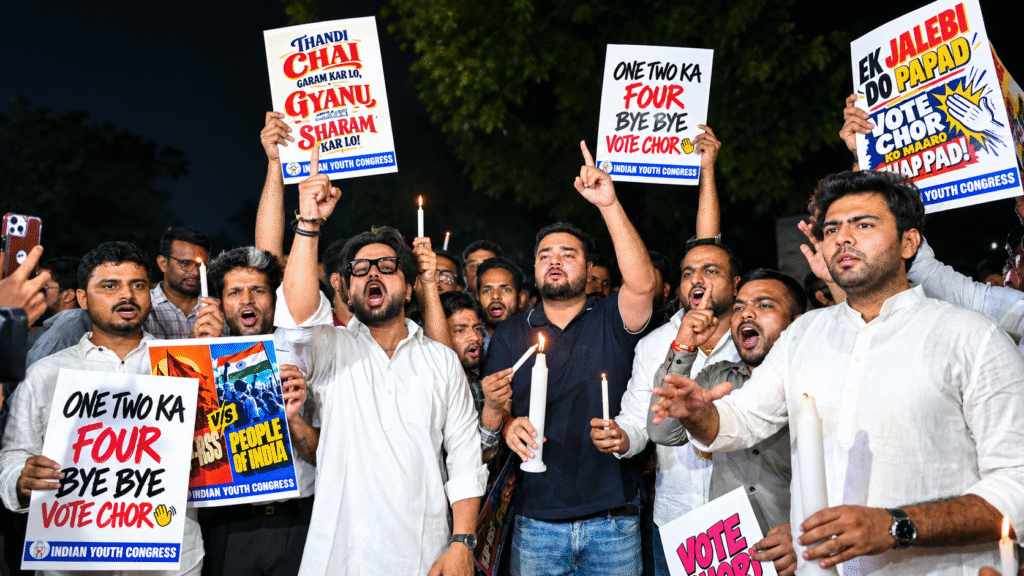
New Delhi, October 4, 2026 – The protest demanding the removal of Chief Election Commissioner Gyanesh Kumar stretched into its third straight day on Sunday, and by evening the streets around Ashoka Road and the Shangri-La intersection looked like a scene of mass detention. Hundreds of students, activists and ordinary citizens were picked up by Delhi Police as they tried to march towards Jantar Mantar. Among those taken away was AISA national president Neha Bora – detained for the third consecutive day – and a woman journalist who only a day earlier had accused a police officer of sexual harassment while covering the same agitation. The march, organised under the banner of the All India Students’ Association and backed by several civil society groups, began from Andhra Bhawan circle in the afternoon. Protesters carried placards calling for Kumar’s resignation and an immediate halt to the Special Intensive Revision of electoral rolls. They alleged that the SIR process had led to large-scale and irregular deletion of voter names. The crowd included students from different universities, members of youth organisations, and a few senior activists who have been part of the stir since Friday. Police had already put up multiple layers of barricades. When the march reached the Shangri-La intersection, officers blocked the road. What followed was a familiar pattern of the past three days: pushing, dragging, and people being forced into buses and private vehicles. Videos circulating later showed male officers handling women protesters, and one clip captured a man being shoved into a bus with his head pressed down. Neha Bora was taken around 5 p.m. AISA claimed she was pulled into a private SUV by male personnel who were not wearing name badges, and that no woman officer was present inside the vehicle. Her colleagues said they did not know her exact location for some time. Police later confirmed she had been detained and taken to Narela Industrial Area police station. She was released in the evening, as were most others. The woman journalist who had alleged sexual harassment on Saturday was also among those detained on Sunday. She had gone to the Parliament Street police station the previous night with her complaint, and on Sunday she joined the march. After being taken away she told people nearby, “Instead of arresting the accused police officer, they have detained me. Is this justice?” Delhi Police has said that three women journalists filed complaints of sexual harassment against officers during Saturday’s protest, and that the complaints have been transferred to the Crime Branch for inquiry. No FIR has been registered so far, according to reports. Estimates of the number detained varied. Some accounts put the figure at around 250, others said nearly 500 people were picked up from different points in central Delhi and shifted in 10 to 15 buses. Police sources later spoke of roughly 110 detentions and claimed 12 to 15 officers were injured during scuffles. Heavy deployment – nearly 5,000 personnel including Rapid Action Force units, drones and CCTV monitoring – was visible throughout the day. Prohibitory orders under Section 163 of the BNSS remain in force in the New Delhi district. The protest itself is part of a wider anger over the ongoing SIR of electoral rolls. Opposition parties and activists have accused the Election Commission of opacity and of allowing deletions that could affect the fairness of future polls. The Commission has maintained that the exercise is meant to clean up duplicate and ineligible entries. Gyanesh Kumar has not issued any public comment on the street protests. On the ground, the mood among those who managed to stay out of police vans was defiant. “We will come again tomorrow,” several young protesters said as they regrouped near the barricades. Similar demonstrations were reported in Mumbai, where the Thackeray brothers led a march on the same issue. By late evening most of those detained had been released. The journalist who alleged harassment was also let go. But the questions she and the other two women raised remain unanswered. The Crime Branch inquiry is yet to begin in earnest, and the demand for Kumar’s removal continues to echo on Delhi’s streets for a third day. Sources:The Hindu, Indian Express, The Wire, Times of India, CNBC-TV18, Telegraph India, Deccan Herald, News18, Hindustan Times (reports dated 3–5 October 2026).
If Gyanesh Kumar Goes, Modi Will Have to Follow Suit: Dipke
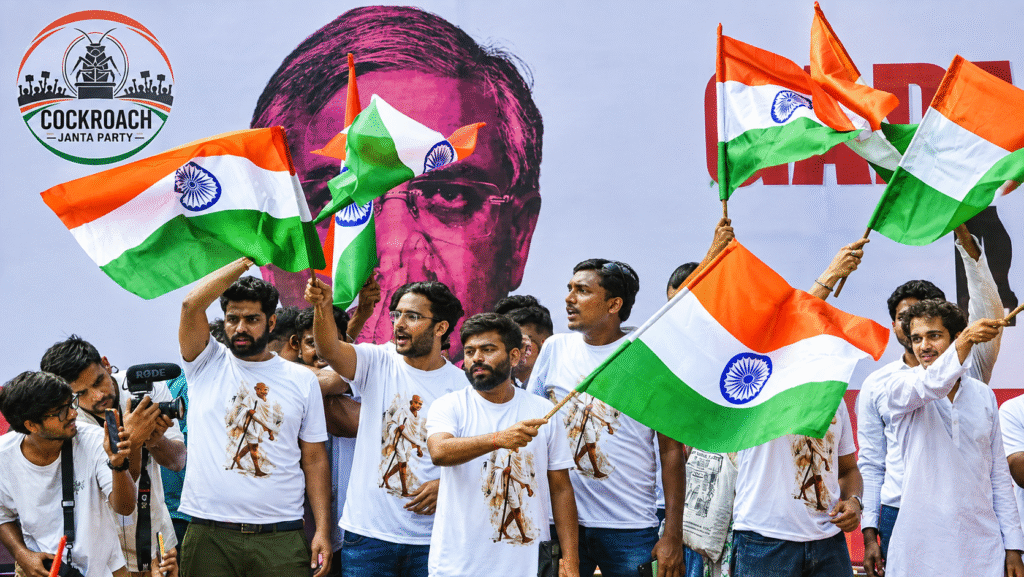
Mumbai, October 3 – Abhijeet Dipke is not mincing words anymore. The Cockroach Janta Party founder stood at Shivaji Park in Dadar and said straight out that if Chief Election Commissioner Gyanesh Kumar does not resign, then Prime Minister Narendra Modi will have to go as well. He called the whole thing “vote chori” on a massive scale. Dipke claimed nearly 13 crore names have been struck off the voter lists in the last couple of years. That number, he said, is no coincidence. It lines up with the difference between the NDA and the opposition in the 2024 Lok Sabha polls. According to him, once Kumar took over as CEC, the government started deciding who gets to vote and who does not. “Is this still democracy?” he asked the crowd. Dipke did not stop at the Election Commission. He pointed the finger directly at the Prime Minister. He said Modi is the one pulling the strings. If the Centre refuses to make Kumar quit, then the protests will demand Modi’s resignation next. “If Gyanesh Kumar does not leave his post, the Prime Minister will have to resign,” he told the gathering. He warned that Jantar Mantar 2.0 is coming, and even if they lock him up for three months, he will come back. The protest itself had a mix of young faces. People held placards, did street plays, sang a bit. Dipke announced the next steps: similar protests in Goa, Karnataka, West Bengal, Uttar Pradesh, Bihar and Jharkhand. If nothing happens by the end of October, they will camp at Jantar Mantar in Delhi. He made it clear CJP will not join the opposition’s planned protest on October 6. They want to stay separate. He put the current mess in a longer story. After 2024 did not go as the BJP hoped, he said they turned to voter-list changes in Maharashtra, Delhi, Tamil Nadu and West Bengal. Leaders like Mamata Banerjee, Stalin and Kejriwal, he claimed, lost because so many voters simply disappeared from the rolls. At the same time, he said the party let opposition governments stay in some places while tightening its grip on the bigger states. He compared it to match-fixing. Dipke also spoke about the constant party-hopping. He said 111 sitting MLAs and MPs switched sides between 2022 and 2026. If legislators can be bought like that, why bother with elections at all? Just auction the seats like IPL players, he said. He brought up the splits in Shiv Sena, NCP and other regional parties, arguing the real aim is one country, one party. There is the internal report hanging over everything. The Indian Express had detailed how Election Commissioners Sukhbir Singh Sandhu and Vivek Joshi put formal objections on record at least 14 times in ten months. Some of those notes said decisions were taken without them even knowing. The Commission’s line has been that different views are normal and every order is legally sound. Kumar is a 1988-batch Kerala cadre IAS officer. He became CEC in February 2025. Earlier he worked in the Home Ministry around the Article 370 decision and the Ram temple trust. He was the first CEC chosen under the 2023 law that changed how the panel is selected. Opposition parties have been after him for months over the Special Intensive Revision. CJP has now raised the stakes by tying his job to the Prime Minister’s. Dipke also made a broader appeal. He said the last twelve years have been spent dividing people on Hindu-Muslim lines. He asked people to put that aside and stand together as Indians first. Support whoever you want, he said, but right now the vote itself is under threat. Whether any of this forces a resignation is another matter. The Election Commission has given no sign that Kumar is leaving. The government has treated the internal notes as ordinary differences. Still, Dipke’s words at Shivaji Park have made the demand sharper. In his telling, Kumar and Modi are now linked. The protests are set to continue, and CJP says it will not back down until the CEC goes. Sources:ETV Bharat report on Dipke’s Mumbai statements, October 3, 2026Deccan Chronicle, Hindustan Times, Outlook India, ThePrint, Moneycontrol and PTI coverage of CJP protests and the SIR row, September 24 to October 2, 2026Indian Express investigation into objections inside the Election Commission @Rohit Manral
Congress Hits Streets Across India Demanding CEC Gyanesh Kumar Quit; AISA’s Neha Among Those Picked Up at Jantar Mantar
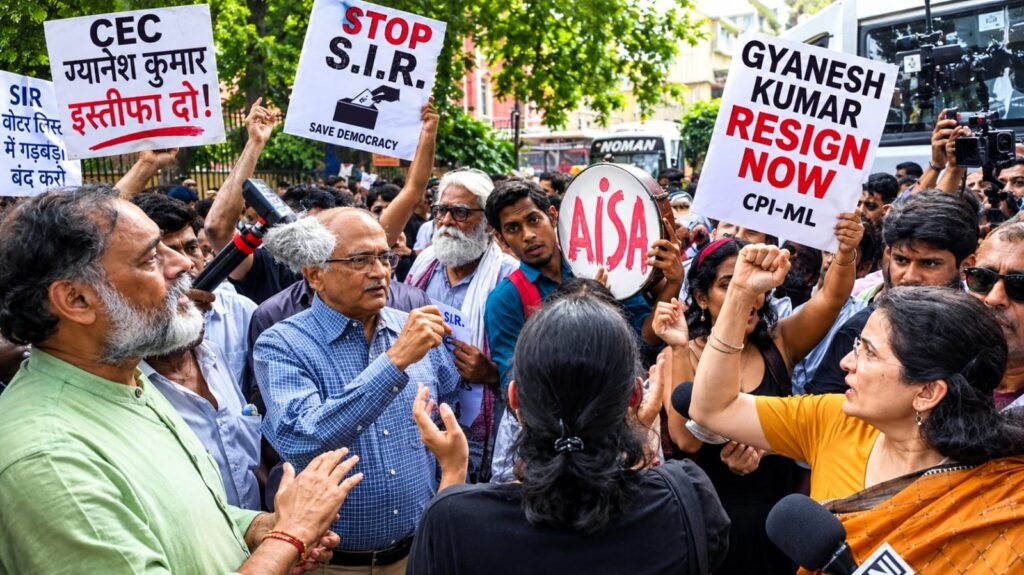
Yesterday on Friday the Congress and a bunch of student and civil society groups went all out against Chief Election Commissioner Gyanesh Kumar. They’re saying he has to resign, some are even calling for his arrest. The whole thing is boiling over because of that Special Intensive Revision of the voter lists and that report about two other Election Commissioners raising objections several times. In Delhi the main action was around Jantar Mantar. AISA had called a protest, and a lot of familiar faces showed up – Neha Bora (she’s the AISA president), Dipankar Bhattacharya from CPI(ML), Yogendra Yadav, Prashant Bhushan, Anjali Bhardwaj and others. Police said nobody had taken permission, so they started rounding people up. Neha was among those detained. They took her to Kanjhawala police station. From there she sent out a video saying basically, “We only came to demand accountability. We’ll be back tomorrow.” Altogether police picked up around 150 people from three spots near Jantar Mantar and DDU Marg. Most were released by evening. Delhi Congress chief Devender Yadav was also detained when his group tried to march towards the Election Commission office. It wasn’t just Delhi. Congress workers came out in a lot of places. In Patna the police turned water cannons on them. Same thing in Chandigarh. In Imphal they used tear gas. In Guwahati they detained Gaurav Gogoi. In Lucknow the state Congress president was taken away. People burnt effigies, shouted slogans, the usual scene. K.C. Venugopal from the Congress made it clear they’re not stopping. He said the protests will continue till Kumar goes. They’re talking about moving notices in Parliament and they’ve already announced district-level protests for Monday. There’s a CWC meeting on Tuesday too. The other side is saying this is all political drama. The Election Commission maintains that internal differences are normal and the final decisions on the SIR were unanimous. Police keep repeating that no permission was given, so they had to clear the area. That’s pretty much where things stand right now. The opposition is treating this as a big fight over the fairness of the electoral process, and the government and the EC are holding their line. Looks like next week is going to be noisy as well. Sources: The Hindu, Hindustan Times, Indian Express, Siasat, Telegraph India, Deccan Chronicle, National Herald (25-26 September 2026 reports). @Rohit Manral