Mohan Bhagwat warns of forces trying to destabilise India: ‘Regime change doesn’t change circumstances’
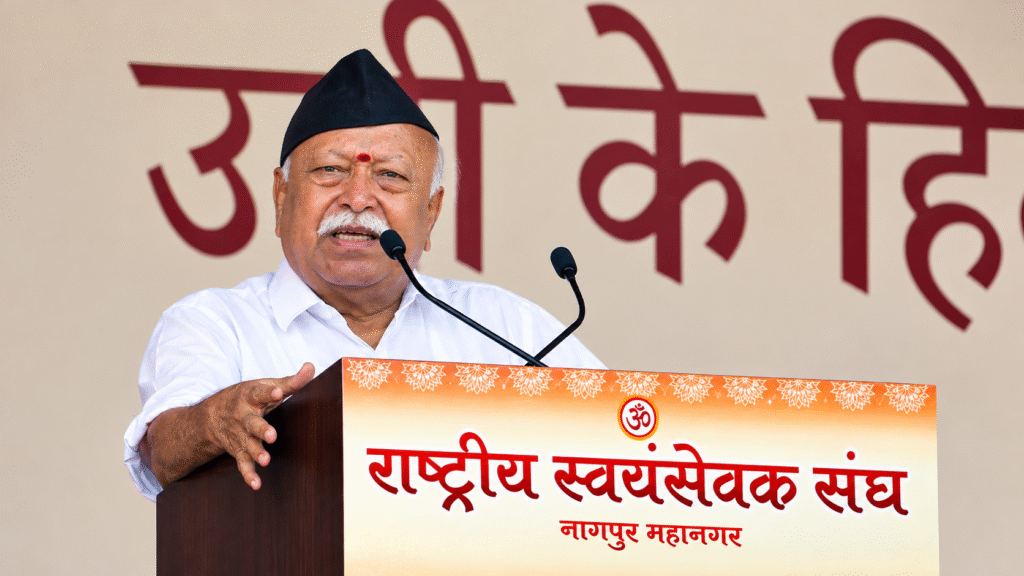
Nagpur, October 20: Rashtriya Swayamsevak Sangh chief Mohan Bhagwat on Tuesday delivered a clear message at the organisation’s annual Vijayadashami Utsav. He said certain forces are actively working to destabilise India, and that the idea of simply changing the government to fix everything is a myth that has never worked. Speaking at Reshimbagh ground, Bhagwat pointed to recent turmoil in other countries. “Look at what is happening in France, Albania, Bangladesh and Nepal,” he said. “They say regime change will change the circumstances of the country but that has never happened. It did not happen earlier, and it will not happen now.” He described a “storm” blowing in from the West — one that opposes order, culture, systems, security and basic human values. According to him, these forces see India’s steady progress over the past few decades as a threat. “India is their main target because India is progressing. These evil forces know that they cannot disrupt India the way it has moved ahead with decisive policies in the last few decades… they are trying dismantling India and the Sangh,” Bhagwat said. He did not stop at external players. Bhagwat noted that some people inside the country, driven by ambition or a simple hunger for power, end up helping these efforts. He called them people of “low intelligence and thirst for power” who reflect what the foreign forces want. The goal, he suggested, is not genuine improvement for ordinary citizens but to keep certain interests dominant by creating chaos. The remarks come against the backdrop of ongoing protests in Delhi and elsewhere demanding the resignation of Chief Election Commissioner Gyanesh Kumar over alleged irregularities in the Special Intensive Revision of electoral rolls. Days earlier, senior lawyer Prashant Bhushan had described the agitation as “really a fight for regime change.” Bhagwat’s speech appeared to address that line of thinking directly without naming anyone. On protests themselves, the RSS chief was measured. He accepted that public demonstrations are a natural part of democracy. Problems will keep arising in a large, developing society like India’s, and people have every right to raise their voice. But the purpose matters. “Protests should seek solutions to problems rather than create further divisions,” he said. Solutions, he insisted, ultimately come from within society through dialogue and constructive effort, not from continuous agitation that sows bitterness or hostility between different sections of people. Bhagwat recalled older history too — how Lord Curzon once tried to divide Bengal, only for the Vande Mataram movement to force a reversal within a few years. The 1947 Partition, he said, happened because people accepted the idea that they looked different and therefore were different. The intended goals of that division were never fully achieved, he added, leaving only restive borders. The lesson he drew was simple: stay united and alert. No one can unsettle a society that refuses to be divided. He also spoke about the younger generation’s growing sense of national pride and responsibility. That awakening, combined with firm policies and steady leadership in recent decades, has already frustrated earlier attempts to weaken the country. These forces know it, which is why India remains their ultimate target. Throughout the address Bhagwat returned to the same practical point. Changing who sits in power does not automatically fix deep-rooted issues. Countries that have gone through sudden regime shifts often find the same problems — or worse ones — still staring at them. Lasting change requires social cohesion, shared purpose, and a willingness to solve problems rather than weaponise them. In a large and still-developing nation, challenges will continue. Bhagwat’s advice was straightforward: stay within constitutional limits and civil decorum, keep protests focused on solutions, and refuse to let ambition or external influence tear the social fabric. Unity and alertness, he said, are the real safeguards. The speech, delivered on the occasion of Vijayadashami, mixed caution with confidence. India’s progress has made it a target, but the same progress and the rising confidence of its people have also made success for those trying to dismantle it far harder than before. Sources:Hindustan Times, The Tribune, The Indian Express, India Today, Moneycontrol, Deccan Herald, ANI reports from the Vijayadashami Utsav in Nagpur on 20 October 2026. @Rohit Manral
‘In America, behave true to America’: Mohan Bhagwat tells Indian diaspora to fulfil duty to ‘karma bhumi’
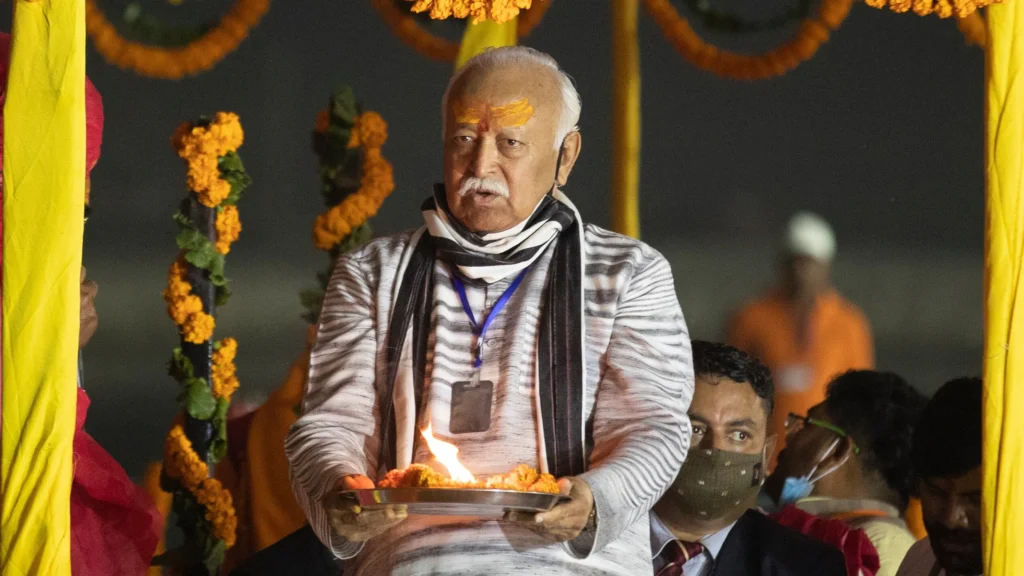
New York, August 30: Rashtriya Swayamsevak Sangh (RSS) chief Mohan Bhagwat stood before a packed hall at Madison Square Garden’s Infosys Theatre on Saturday and spoke straight to the Indian community living in the United States. His message was simple and clear. India remains your janma bhumi — the land of your birth. But the country where you now live, work and earn is your karma bhumi — the land of your duty. And that duty comes first. “What is our duty? We are in America, we live in America, we earn in America. So we are American. And we should behave true to America,” Bhagwat told the gathering of more than 6,000 Indian-Americans and interfaith leaders. “The diaspora, Bharatiya diaspora, they have a duty to their karma bhumi. They must fulfil that. They should be loyal to their karma bhumi.” The event, called the Universal Oneness Celebration, was organised by American Hindus for Engagement and Dialogue (AHEAD). Bhagwat’s nearly hour-long address mixed civilisational ideas with practical advice for people who have built lives far from home. He did not ask the diaspora to turn away from India. He simply set an order of priorities. If someone feels an urge to do something for Bharat after meeting their responsibilities in America, that is fine, he said. “It is not prohibited. But it is not obligatory.” What India does expect, he added, is that people carry the values they received from their motherland into their daily lives. The most important of those values, according to him, is oneness — the sense that we are connected to other human beings and to nature. Bhagwat drew a parallel between America’s idea of pluralism and India’s long-standing phrase “unity in diversity.” Both, he said, sit in the DNA of the two societies. “We are one, and due to diversity, that oneness is decorated. So diversity has to be celebrated, respected, and accepted. And at the same time, we must keep in mind this feeling of oneness.” He invoked Swami Vivekananda to underline that every nation has a destiny to fulfil. Bharat’s role, in his view, is to keep showing the world that unity and diversity can live together — not through lectures, but through practice. The speech went beyond the diaspora question. Bhagwat spoke about the limits of material success. Earning well and collecting things is not the full measure of a life, he suggested. People depend on farmers, workers, families and the wider society. That dependence creates a responsibility to give something back. He also touched on the tension between development and the environment, saying the old Indian approach of balance offers a way forward that neither destroys nature nor freezes progress. For many in the audience, the core line about karma bhumi carried particular weight. Large numbers of Indian-Americans have built successful careers in technology, medicine, business and academia. They send money home, stay connected to family, and take part in cultural events. At the same time they pay taxes, raise children who grow up American, and contribute to the communities around them. Bhagwat’s framing gave that dual reality a clear language: first be a good citizen where you live; the link to India remains through values and, if circumstances allow, through voluntary help. He was careful not to create a sense of obligation toward India. “Your janma bhumi expects you to live the values it has imparted on you,” he said. The expectation is cultural and ethical rather than financial or political. Live the idea of oneness. Respect diversity while holding on to the feeling of unity. Give back to the society that supports you. That, in his telling, is how the diaspora fulfils its connection to Bharat while remaining true to America. The gathering itself reflected the themes he raised. Interfaith leaders spoke before Bhagwat about oneness and mutual help. The audience came from different professions, different parts of India, and different generations. Some had arrived decades earlier; others more recently. The setting — one of New York’s best-known venues — underlined how established the Indian presence has become in the United States. Bhagwat’s remarks fit a broader pattern in his public speaking. He often returns to the idea that nations are more than maps and that civilisations carry responsibilities. In New York he applied that thought directly to people living between two homes. Be loyal to the place that gives you work and livelihood. Carry the deeper values from the place that shaped you. Do not treat either relationship as a burden or a transaction. By the time he finished, the central message had been repeated in different words but remained consistent. In America, behave true to America. Fulfil the duties of the karma bhumi. The janma bhumi will continue to live in the values you practise every day. Anything more is welcome if it comes after that foundation is secure, but it is not demanded. The speech is already circulating among Indian community groups and in media coverage back home. For many who heard it in person or later online, it offered a practical and respectful way to think about belonging in two places at once — without guilt, without conflict, and with a clear sense of priority. Sources: Hindustan Times, India Today, ANI, IANS, The Times of India, ThePrint (PTI), India TV, The Indian Express, Rediff, News9live (reports dated August 30, 2026, covering Bhagwat’s address at the Universal Oneness Celebration, Madison Square Garden, New York, August 29, 2026). @Rohit Manral