‘Not expecting neighbours to do only what’s in my interest’: Jaishankar on Bangladesh amid Hasina row
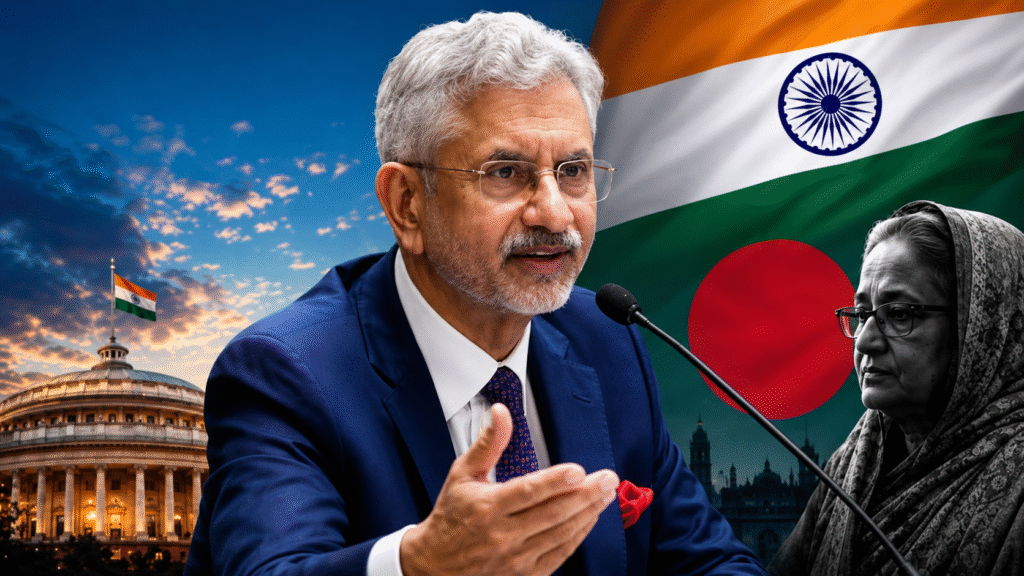
External Affairs Minister S. Jaishankar was saying on Saturday when he spoke about India and Bangladesh.He was at the Economic Times World Leaders Forum in Delhi, and someone asked him about the current awkwardness between the two countries—especially Bangladesh’s demand that India hand over Sheikh Hasina, and the question mark hanging over a possible visit by Bangladesh’s new Prime Minister Tarique Rahman. Jaishankar didn’t get into the details of any private talks. He rarely does. Instead he kept it simple and practical. He said, “What I can tell you is for any relationship to work, it has to meet the test of mutual interest. It has to work for them, it has to work for us.” Then he added the line that really stays with you: “I am also realistic, I’m not expecting neighbours to do only what’s in my interest. There has to be a fair degree, a reasonable degree, of my recognising and respecting what is their interest, just as I expect them also to do so.” He went on to say that once both sides find that common ground—that “landing point”—things start moving more smoothly. At the end of the day, he said, mutuality is what holds these relationships together. It’s a calm, grown-up way of putting it at a time when things have been a bit tense. Sheikh Hasina has been in India since August 2024, when she left Bangladesh during the big political upheaval. Bangladesh has been asking for her return so she can face the cases against her there. Some reports say Dhaka has even linked that demand to Rahman’s possible trip to India. New Delhi has invited him—both for a regular bilateral visit and in connection with the BRICS summit, since Bangladesh chairs BIMSTEC right now. But the timing has been uncertain, and the Hasina issue keeps sitting in the background. After 2024 the relationship took a real knock. There was coolness, some trade friction, sharper public comments. When Tarique Rahman took charge earlier this year, it looked like both sides were trying to steady the boat a bit. Then Hasina did a virtual media interaction from India on the second anniversary of her departure, and that seemed to irritate Dhaka all over again. India has said it didn’t organise or endorse that interaction, but the episode still added to the strain. Jaishankar’s answer didn’t pick a fight and it didn’t give anything away either. He just stated the obvious truth: lasting ties can’t be one-sided. India has its own interests—border security, connectivity for the Northeast, trade, regional stability. Bangladesh has its own priorities, shaped by what its people and its politics want right now. Pretending those don’t exist doesn’t help anyone. He’s talked about neighbourhood diplomacy this way before. What feels refreshing is that he isn’t treating this as a zero-sum game. He’s not saying India holds all the cards, and he’s not saying Bangladesh has to simply fall in line. The message is quieter and more realistic: both sides need to feel they’re getting something out of it. That applies whether you’re talking about high-level visits, legal requests, border management or the everyday economic links that ordinary people actually feel. And ordinary people do feel it. Cross-border trade, medical travel, family visits, the movement of goods—those things matter more than diplomatic language. When the temperature stays high for too long, those practical connections start to suffer first. Finding common ground, as Jaishankar put it, is less about grand speeches and more about the patient work of spotting where interests overlap and managing the differences that will always be there. Right now the two governments are still talking about the visit. Whether it happens soon or takes a little longer, the larger point he made still holds. Neighbours don’t have to agree on everything. They just have to accept that each has legitimate interests of its own. Expecting only one side to adjust is a sure way to keep the friction going. Looking for the place where interests meet is the more practical path—and the one he said India is ready to take. In the end it’s the kind of plain-spoken view that doesn’t make for dramatic headlines, but it might actually help keep the relationship from drifting further off course. Mutual interest isn’t a fancy slogan. It’s just the basic condition for any lasting neighbourhood arrangement. And right now, that’s exactly what both sides need to remember. Sources: Hindustan Times, The Indian Express, India Today, Zee News, News18, India TV, WION, The Daily Star, Firstpost, Times of India (coverage of Jaishankar’s remarks at the Economic Times World Leaders Forum, 22–23 August 2026). @Rohit Manral