Some won’t admit they read it, HarperCollins CEO quips as Sonia Gandhi’s book breaks records

Sonia Gandhi’s memoir, Belonging: A Journey of Love. The numbers are wild. HarperCollins India says it’s already sold more than two lakh copies in under a week since it hit the stands on 10 November. That’s not just good sales. The publisher is calling it the fastest-selling book, the fastest-selling debut, the fastest-selling non-fiction title and the fastest-selling memoir they’ve seen in this country. On the day it launched, more than 15,000 copies were delivered in less than ten minutes. Apparently that’s a first for Indian publishing. The formal launch happened on Monday in Delhi, packed hall, opposition leaders, writers, a few chief ministers, the usual crowd for something this high-profile. HarperCollins India CEO Ananth Padmanabhan stood up and delivered the line that got the biggest laugh of the evening. “There are now only three categories of people in India,” he said. “Those who have bought and read Sonia Gandhi’s memoir, Belonging: A Journey of Love; those waiting for their purchased copies to arrive; and those who have read it but lack the courage to admit it.” Sonia and Rahul, sitting right in front, both cracked up. The room joined in. It was the kind of light moment that cuts through the heavy political air that always follows this family. Padmanabhan didn’t hide how tight the timeline had been. HarperCollins got the book with less than twelve weeks to go. How they ended up with it is “a story for another day,” he said, which is publisher-speak for “we’re not getting into that right now.” Everyone in the room knew the background anyway. The book was originally supposed to come out with Penguin Random House India. That deal fell apart over editorial changes the author didn’t want to make. Congress people said the publisher got nervous about criticism of the government. Penguin said it was just the normal back-and-forth of editing. Either way, HarperCollins stepped in and somehow pulled off a nationwide release that looked like it had been planned for months. Sonia herself seemed genuinely taken aback by the response. At the launch she said she expected people to take an interest over a few weeks, not this kind of rush. “This has been overwhelming, unexpected and overwhelming,” she told the gathering. You could hear the surprise in her voice. For someone who has spent decades in the public eye, still being able to say that about a book feels rare. Booksellers had been bracing for demand, but the scale still caught a few by surprise. In Delhi, stores that ordered a few hundred copies on day one were already reordering. One bookseller compared the early frenzy to the old Harry Potter days, which is not a comparison you hear lightly. Online platforms and quick-delivery apps were moving copies at a clip that made the usual bestseller lists look sleepy. Pre-orders had been strong for weeks, and the moment the embargo lifted at 10 am on the 10th, the rush started. The book itself is a mix of the personal and the political, the kind of memoir people expected from her. It covers her childhood in Italy, the Cambridge meeting with Rajiv, life with Indira Gandhi, the assassinations that changed everything, and the reluctant years that followed. Readers who have already finished it talk about the quieter passages as much as the political ones. That combination seems to be part of why the sales keep climbing even after the first wave of curiosity. Of course, not everyone is celebrating. In a polarised country, a book by Sonia Gandhi was never going to be just another title on the shelf. Some will buy it and never mention it. Some will criticise it without opening it. Padmanabhan’s joke about the third category landed because it felt true. You can almost picture people reading it late at night and then carefully putting it away so no one sees the cover. HarperCollins is treating the numbers as confirmation that the appetite was always there. Two lakh copies in a week is the kind of figure that makes other publishers look at their own lists and wonder what they’re missing. For Sonia, it seems to be something simpler: proof that after all these years, people still want to hear the story in her own words. The book is still moving. More print runs are already in motion. Whether the sales keep this pace or settle into a steadier rhythm, the opening week has already written its own record. And somewhere out there, according to the man who published it, there are readers who finished every page and still won’t say a word about it. That’s Indian publishing for you — numbers on the one hand, quiet reading on the other. Sources:Business Standard, The Hindu, India Today, Indian Express, HarperCollins India press material, Economic Times. @Rohit Manral
Little real contact with Modi, but there is some common ground: Sonia Gandhi in memoir Belonging
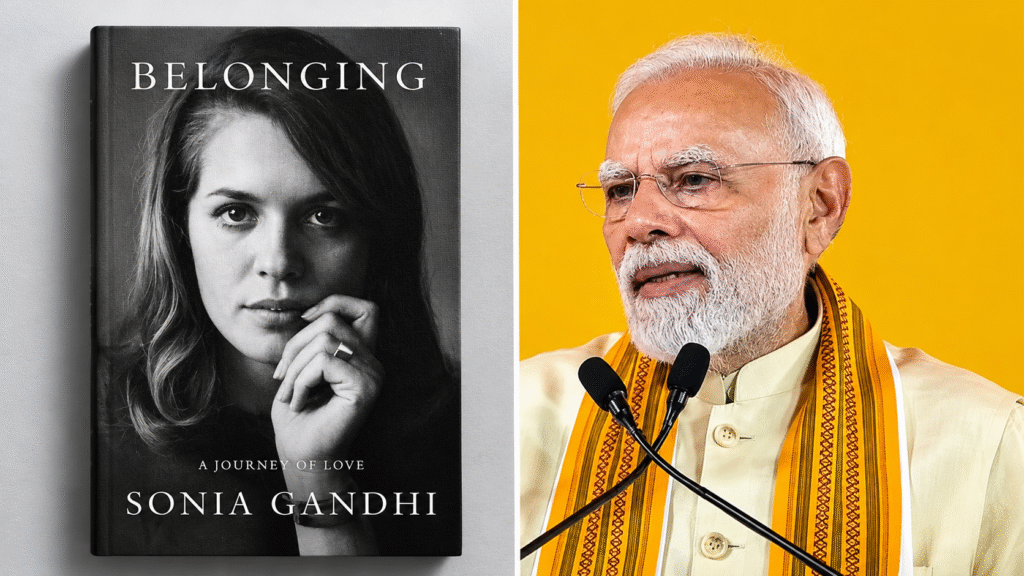
Sonia Gandhi’s book Belonging: A Journey of Love is out, and one of the quieter bits that stands out is what she says about Narendra Modi. For more than ten years the two of them have been on opposite sides of almost every big political fight in the country. Yet she writes that she has had practically no real contact with him at all. They meet sometimes at semi-official things, like in the Speaker’s chamber. When they come face to face it is just a formal namaste and nothing more. She notes that this is different from the old days, when leaders from different parties still managed a bit of warmth. He tends to look away, she says, avoiding eye contact. She is clear that the rivalry was never personal. He was pushing his vision of India, she was pushing hers — an India against hegemony, one that stands for inclusiveness, secularism and social justice. Still, she finds a few places where their experiences sort of meet. She writes that there were parts of his discomfort with the ruling elite of those years that she also understood. She often felt out of place in a Delhi drawing room during political talk, sensing that what people were saying had very little to do with the real India outside. She even notes that he had worked his way up inside the RSS from a modest background. It is a careful, understated way of putting it. No anger, no soft-pedalling either. The political battle between them has been long and hard. In the book she simply records that their personal meetings stayed rare and strictly formal. The rest of the memoir covers much more ground — her childhood in Italy, meeting Rajiv in Cambridge, learning to live in India, the losses that changed everything, and the slow pull into politics. She has said more than once that this is a personal book, not a political one. She wanted to write about the people she knew and loved, with all their strengths and flaws. The political parts are there, but they sit inside a larger story of finding a place to belong. Anyone who has watched the years of confrontation between Congress and the BJP will probably stop at these pages. The formal namaste, the averted eyes, the quiet admission that both of them sometimes felt uneasy among the Delhi elite — it feels like a small, honest window into a relationship that never became personal even while the politics stayed fierce. Sonia does not claim to know what is in Modi’s mind. She just puts down what little contact there has been and notes the few spots where their experiences of discomfort seemed to overlap. Whether that counts as common ground is for the reader to decide. For her, it was enough to say it plainly. The book is 544 pages long and takes in a whole lifetime. These few paragraphs about Modi are only a small corner of it. But in a country where every exchange between the two sides is watched closely, even a short account of distant, formal meetings carries weight. She has written it the way she saw it: almost no real contact, a formal greeting when they meet, and a quiet recognition that both, in their own ways, felt out of place in certain rooms in Delhi. Sources: Hindustan Times reporting on Belonging: A Journey of Love by Sonia Gandhi (HarperCollins India, 2026); related coverage in News18 and Moneycontrol.
How a Love Story Grew into a Deep Belonging to India
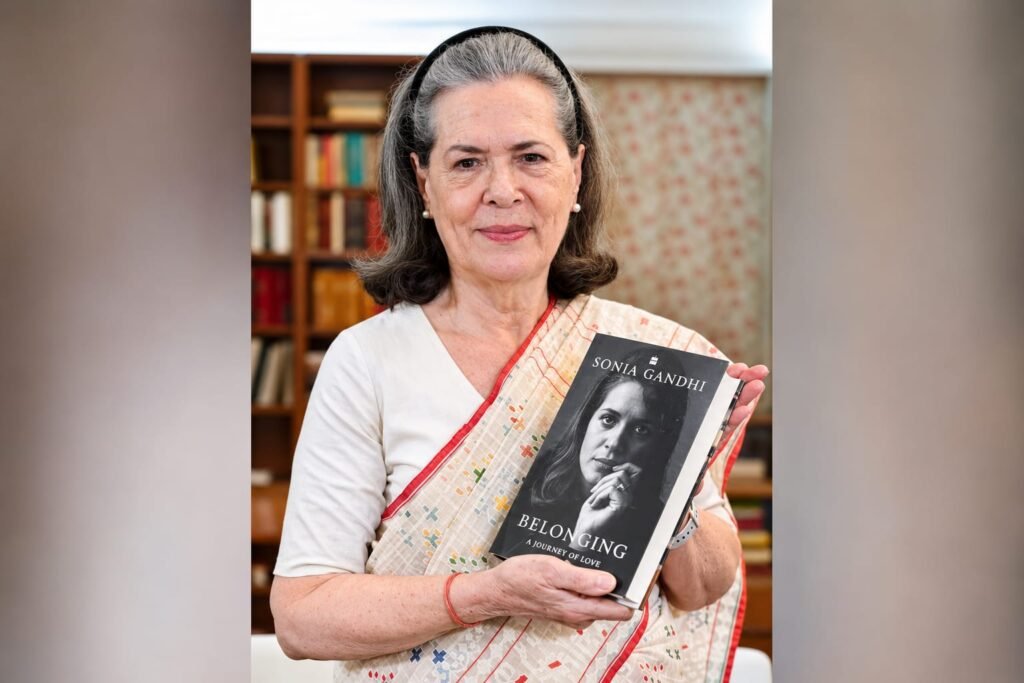
Sonia Gandhi’s new memoirBelonging: A Journey of Love is exactly that kind of story. It’s out now from HarperCollins India, and it’s the one people have been waiting for. She calls politics just “a kind of framework” in the book. The real heart is personal. A young Italian girl falls hard for a quiet Indian man in Cambridge, follows him home, and slowly the country becomes hers too. It begins in 1965. Sonia Maino is nineteen, studying in England. She walks into a Greek restaurant and meets Rajiv Gandhi. Instant. She later said it was a coup de foudre — love at first sight. His eyes, she remembers, told you who he was inside. Loving, comforting, caring. Everything she could have dreamed of. She had no idea then that his grandfather was Jawaharlal Nehru or that his mother would become prime minister. She just knew she wanted to be with him. They marry in 1968. She moves to India. Suddenly she’s learning Hindi, figuring out how to wear a sari (she already thought it was one of the most elegant things in the world, but wearing one herself was another story), and tasting food that set her mouth on fire. That first tandoori chicken was bright red, slightly charred, and fierce. And then the daily arhar dal. The unfamiliar became familiar. The familiar became loved. That’s how belonging starts sometimes — one plate at a time, one careful fold of cloth, one new word. Rajiv and Indira are the two big figures in her story. She says when she arrived as a young bride she knew nothing about India. Everything she is and knows today, she learned from them. Their courage, their empathy, their commitment to a secular and democratic country, and most of all that pull of duty that was stronger than anything else. It inspired her and held her steady when things got hard. Life with Rajiv was happy for a while. They raised Rahul and Priyanka. He flew planes. She stayed private. She admits she always disliked politics, even while he was in it. She resisted. Then the losses came one after another. Sanjay’s plane crash. Indira’s assassination in 1984. Rajiv stepping into the prime minister’s job. And seven years later, Rajiv himself killed by a suicide bomber on the campaign trail. That last one broke her open. Everything around her echoed the loss. She found some comfort in work that kept his memory alive, but public appearances still left her fragile. The Dalai Lama once asked her if she felt vengeful toward the people who killed Rajiv. She said no, and then just started crying. Duty started tugging at her the same way it had tugged at him. She saw the party weakening. She saw the purpose of all those sacrifices being threatened. Her children didn’t want her to step in. She herself felt she had no special right beyond the family name. But something woke up. She writes that she finally knew the answer to her own doubts. She had to go where duty called. And she did. The book doesn’t shy away from the hard parts. In 1999, when some party leaders questioned her foreign origin and said she couldn’t hold high office, she felt the hurt. It came as a shock that they still saw her as an outsider. She submitted her resignation as Congress president and later withdrew it. Years later, after the 2004 election, the party wanted her as prime minister. She said no. She chose to lead from the side instead, helping run the alliance that governed for a decade. She has said she doesn’t regret that decision. Looking back now, she still carries the values she grew up with in post-war Italy. But she laughs less than the young woman who once met a dark-eyed student in a Cambridge restaurant. The smile is quieter. The belonging is deeper. What stays with you after reading is how personal it all remains. This isn’t a political score-settling book. It’s a woman telling the story of how love for one person opened the door to a whole country, a whole family, and a life she never planned. How loss forced her into public view. How duty kept her there. How, over decades, the girl from a small village in Veneto found herself at home in India. Stranger than fiction, someone asked her. Yes, she answered. That’s one reason she stayed quiet about it for so long. But it isn’t only the love story between her and Rajiv. It’s the story of how she grew to love his family and the country they belonged to — and how she came to belong in it too. The book is 544 pages. It’s full of those small, human details that make the big history feel close. Food, clothes, private jokes, quiet moments of doubt, the weight of pictures on the wall. You close it feeling you’ve sat with someone who finally decided to talk. Sources: Sonia Gandhi’s Belonging: A Journey of Love (HarperCollins India, 2026); interviews and excerpts carried by The Hindu publisher statements from HarperCollins India and Alfred A. Knopf; reporting fromThe Indian Express, National Herald, and related coverage of the memoir’s release. @Rohit Manral