
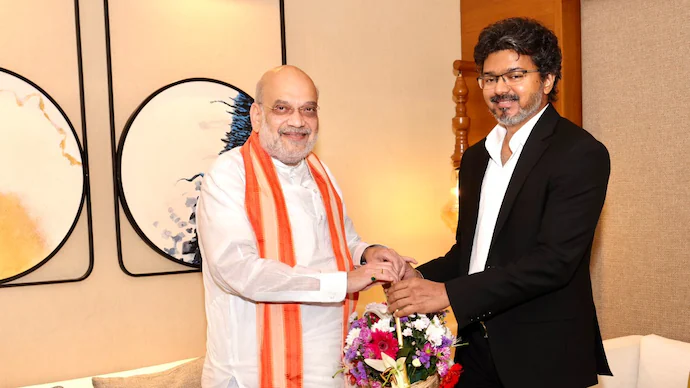
Politics in Tamil Nadu can turn on a dime, and Thursday was one of those days. The DMK came out swinging against Chief Minister C. Joseph Vijay, accusing him of doing a full U-turn on the delimitation issue within a week. The spark? Vijay’s meeting with Union Home Minister Amit Shah at the Southern Zonal Council in Chengalpattu.
Only a few days ago, the Tamil Nadu Assembly had passed a clear resolution. It said the number of Lok Sabha seats should stay frozen at 543 and the present share of each state should not be touched. Vijay’s government had pushed it hard. His party, TVK, had even called an all-party meeting of MPs earlier in the month and got a similar demand on the table. Many people thought the message was loud and clear: no redrawing of seats that could weaken the South’s voice in Parliament.
Then came Thursday. Speaking at the council meeting that his own government was hosting, Vijay took a softer line. He asked the Centre for a firm legal assurance that no state would lose its percentage of seats in Parliament just because it had managed to control its population better. He spoke about how southern states had done well on population stabilisation, human development and economic growth, and said those achievements should not be punished by cutting their representation.
What he did not say was as important as what he did. He never repeated the demand to keep the total number of seats locked at 543. That difference did not go unnoticed.
The DMK’s IT wing was quick on social media. One post said, “Chief Minister Vijay, who took a firm stand against Amit Shah on delimitation… who passed a resolution the same week saying do not increase the 543 seats… has now changed his stance.” Another asked, “Has Chief Minister Vijay done a U-turn in a week on the constituency redrawing issue? Is this the same man who once called supporters of redrawing ‘eight-footers’?” They also needled TVK’s alliance partners, asking if anyone would call out what they saw as double-speak.
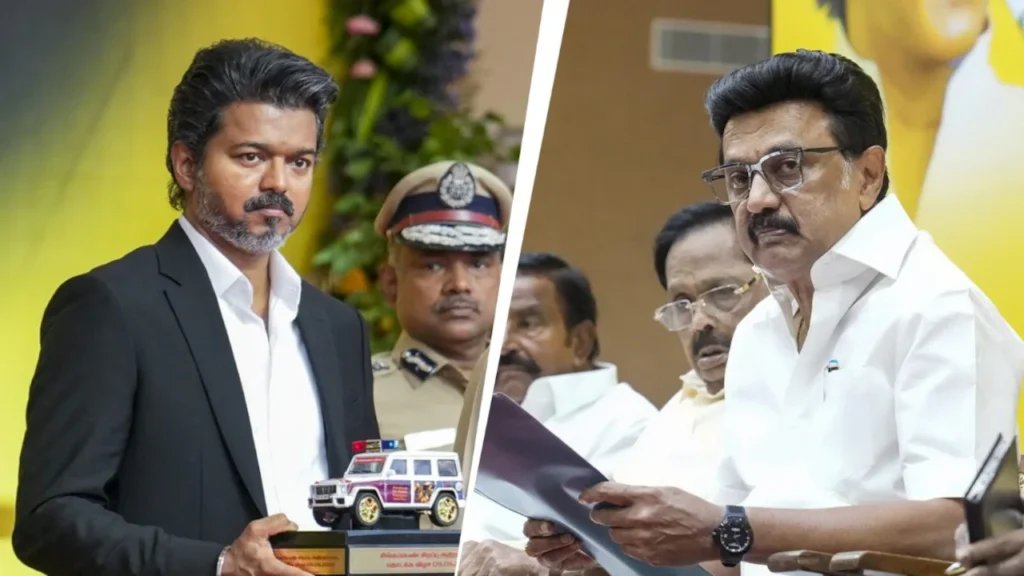
DMK spokesperson Saravanan Annadurai put it simply: the Chief Minister had flipped on the issue. AIADMK’s IT wing joined in, saying the TVK government had completed a full U-turn and was now sounding a lot like the Union government itself. AMMK leader T.T.V. Dhinakaran called the whole sequence political theatre meant to distract from other problems in the state.
The setting made the criticism sharper. Amit Shah was chairing the Southern Zonal Council meeting. Chief ministers and senior officials from Tamil Nadu, Karnataka, Andhra Pradesh, Kerala and the southern Union territories were present. Vijay used the platform to raise three main points: protection on delimitation, exemption from NEET for Tamil Nadu students, and tougher action against drug trafficking and illegal online medicine sales.
On delimitation, the anxiety in the South is old and real. The freeze based on the 1971 Census is coming to an end. If seats are redistributed purely on today’s population numbers, states in the North that grew faster could gain more seats. States like Tamil Nadu, which brought their population growth under control, could end up with a smaller share. Right now Tamil Nadu holds roughly 7.18 per cent of Lok Sabha seats. Losing even a bit of that is seen as a blow not just to numbers but to the state’s weight on language, culture and federal issues.
Vijay’s new wording — protect the percentage, not necessarily freeze the total number — leaves room for the overall size of the Lok Sabha to grow, as long as no state is penalised for doing well on population control. His ministers later insisted there was no change in the government’s position that seats should stay at 543. Energy and Law Minister C.T.R. Nirmalkumar said as much outside the meeting. But the difference in language was hard to miss, and the opposition made full use of it.
This episode shows how carefully Tamil Nadu’s parties are treading. Delimitation is not just about maps and numbers. It goes to the heart of federal balance and regional pride. For years, governments here have resisted anything that could shrink the South’s say in Parliament. Vijay himself had spoken strongly against it earlier, saying Tamil Nadu would not let anyone take away its place.
Now, with the Centre not rushing a new bill and with earlier assurances that southern representation would not be cut, the room for careful language has grown. Some see Vijay’s remarks as practical engagement. Others, especially the DMK, call it a climbdown after the strong assembly resolution.
As the day ended, one thing stood out. The delimitation debate is nowhere near settled. It will keep testing whether Tamil Nadu’s leaders can hold a common line when the state’s long-term interests are on the line. For the moment, the DMK has drawn a sharp line, saying the Chief Minister changed course in the space of a single week. Whether that change is real or just careful wording in front of the Union Home Minister is something the political class will keep arguing over in the days ahead.
Sources:
Times of India, Hindustan Times, Mathrubhumi, Moneycontrol, India Today, The Federal, The Week, ABP Live.
@Rohit Manral